
Aspirant for Deputy Communications Officer for Greater Accra Region Outlines Vision After Filing Nomination
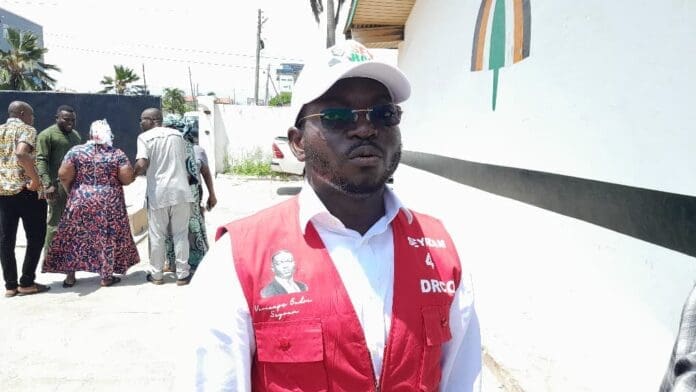
In a decisive move to bolster the National Democratic Congress (NDC) communications apparatus ahead of the 2028 general elections, Mr. Vericaps Seyram Gadri has formally filed his nomination to contest the position of Deputy Communications Officer for the Greater Accra Region.
The filing took place on Thursday, 14th October, 2026, at the NDC Regional Office in La, Accra, marking a significant step in the party’s internal reorganisation efforts as it positions itself for sustained electoral success.
Speaking in an exclusive interview with NewsGhanaonline shortly after submitting his nomination forms, Mr. Gadri emphasised that the party cannot afford complacency despite its current standing in the eyes of the public.
“At this point in time, we are back again; the party has to reorganise ahead of the 2028 elections,” he stated. “Yes, there is some level of certainty that the NDC is going to be in power for a little while, a little longer. But of course, you can’t be complacent and think that because you are doing well in the eyes of the public, you can afford to relax. We cannot do that.”
He stressed that the foremost priority for the party is internal organisation, which he described as the foundation for effectively confronting political opponents.
“The first and foremost thing you have to do is be able to organise yourselves very well, internally, because the only way you can face your opponents—whether you are engaging in a lyrical battle or a lyrical war in terms of the policies your government or your party is putting forward—is to first mobilise and organise yourself well,” he explained. “It is that stage we have reached at this point, and it is the reason why I am also putting myself forward to be part of that whole process and to be able to secure the victory that we look forward to in 2028.”
A Track Record of Service
Mr. Gadri, who brings a wealth of experience to his candidacy, traced his political journey from his days as a student leader at the University of Ghana, where he served as Deputy TEIN Public Relations Officer under the current Member of Parliament for Sangarego, Hon. Ata Issah.
“I eventually became Deputy Constituency Communications Officer for the Ayawaso West Wuogon constituency for the first time in two decades,” he recounted with evident pride. “I was part of the people that turned the seat from blue to green, and it is something I take pride in because we all contributed. In fact, I led operations on the University of Ghana campus. The existing Member of Parliament unfortunately couldn’t even win more than four of the polling stations.”
His trajectory continued upward as he served in the regional communications team of Greater Accra and eventually became a member of the National Communications team. Currently completing a four-year tenure as a member of the NDC’s Energy Committee, Mr. Gadri believes these experiences have adequately prepared him for the challenges ahead.
“I think that these experiences together have built me. They have prepared me for this day or this time,” he noted. “At this point, I am well positioned to augment or support the communications wing of the party.”
Three-Pillar Agenda for Communications
The aspirant outlined a comprehensive three-pronged agenda aimed at transforming the party’s communication strategy in the Greater Accra Region.
First, he proposed the establishment of a Communicators’ Fund to address the chronic under-resourcing of communication officers. Noting that there are 68 communicators within the Greater Accra Region, he lamented that many are forced to fund their own media appearances.
“I used to appear on radio and TV on my own. You have to cater for whatever you have to do to get to the TV and all that,” he recalled. “At this point, I think we need a separate team that will specifically be in charge of raising funds to support communicators. We cannot win an election when you have not been able to explain your policies in a manner that the ordinary Ghanaian can understand. And in doing that, you rely on your communicators.”
The second pillar of his agenda focuses on what he termed “Policy-to-People Communications”—a deliberate strategy to break down complex government policies into digestible information for the ordinary citizen.
“Oftentimes, we sit at the top and we just focus on speaking the big English, but we don’t get to the people at the base, and they are the people that matter in our party,” he observed. “The people at the branch level are the root of the party. They carry all the strength of the party. You don’t ignore them.”
He emphasised the need to target the ordinary Ghanaian—the trader at Malata Market, the vendor at Madina Market, the worker at Agbogbloshie Market—by simplifying government policies so they can understand and appreciate what the Mahama-led administration is doing.
The third component of his agenda is the creation of a dedicated research team to support communicators in real-time. Drawing from his own experience of sometimes feeling underprepared when facing technically savvy opponents on media platforms, Mr. Gadri proposed a support structure that would provide communicators with instant facts and figures.
“While you are on set, there should be somebody checking to know the current inflation rate, making some comparative analysis, checking to know the policy rate, and comparing that to what the case was during the past government,” he explained. “They feed you with these pieces of information in real time, and then you are able to make a superior argument to convince the ordinary Ghanaian.”
A Vision of Support
Mr. Gadri was quick to emphasise that his role, if elected, would be one of support for the substantive Communications Officer.
“I have always reminded myself of the fact that I am going to be deputy, and so my foremost responsibility is to support my substantive,” he stated. “In the event that someone becomes substantive, I will have a duty to support that person’s vision materialises. When that happens and he succeeds, I will consider myself successful because he has succeeded. I will take instructions.”
Appeal to Delegates
In a heartfelt appeal to party delegates, Mr. Gadri expressed confidence in his ability to deliver and contribute meaningfully to the party’s communication efforts.
“I am certain in my mind that I will find favour before your eyes. I am sure that listening to me and knowing the experiences that I have gone through, you will believe and know that I have gained some level of competence that will come in handy in supporting the communications wing and that will be useful in projecting a party in a line that is acceptable, particularly when we are getting ready for the 2028 elections,” he said.
“We are poised for victory. We are poised to lead. We are poised to serve, and we are poised to take the party to the next level. On that note, I look forward to a better day, and I am certain that the delegates will be kind and show me some favour.”
Mr. Gadri also took the opportunity to express his heartfelt gratitude to those who proposed and endorsed his nomination forms and encouraged him to compete for the position.
As the NDC prepares for its regional executive elections, Mr. Gadri’s candidacy represents a blend of grassroots experience, regional exposure, and national-level engagement—qualities he believes are essential for the critical task of communicating the party’s message effectively to the people of Greater Accra and beyond.
By Kingsley Kwabena Asiedu


